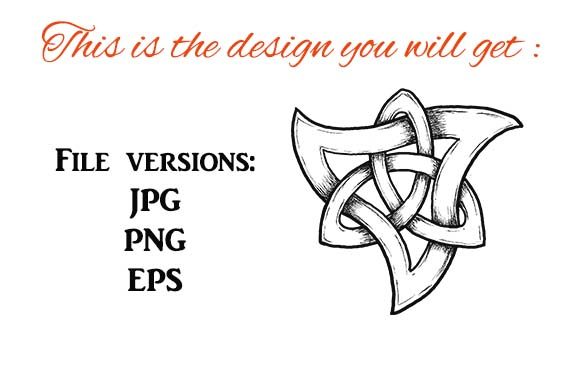
The Triquetra Celtic Knot Design: A Practical Guide to Meaningful Integration
The triquetra — a three-pointed Celtic knot formed from three interlocking arcs — is more than an ancient symbol. For modern creators, entrepreneurs, and professionals, it offers a structured yet flexible design element that can anchor branding, guide creative workflow, and reinforce conceptual clarity. Understanding how to work with the triquetra means moving beyond decoration into purposeful process.
This article focuses on practical integration: how to plan around the triquetra, deploy it during a project, and evaluate its long-term impact. Whether you are a graphic designer, a wellness coach developing a logo, a small business owner refining packaging, or a hobbyist working on a personal crest, the triquetra can serve as both a visual anchor and a process tool.
What the Triquetra Is and Where It Fits in Your Workflow
The triquetra derives from early Celtic art, often associated with the trinity, cycles, and interconnectedness. Its symmetry and continuous line structure make it suitable for logos, icons, borders, and decorative motifs. In a practical sense, the triquetra is a closed-loop design with three equal lobes, meaning it can be drawn, digitized, carved, or printed with repeatable precision.
Where it fits in a broader process depends on your end goal. For a brand identity project, the triquetra might be the central symbol around which color palettes, typography, and supporting graphics are built. For a personal goal-setting system, it can serve as a visual reminder of three core priorities. The key is to treat the triquetra not as an isolated decorative element but as a node in a larger system of decisions and actions.
Pre-Project Preparation: Research and Context
Before committing to a triquetra design, assess its semantic weight. The symbol carries historical and cultural significance, particularly within Celtic and Neopagan traditions. If you are designing for a client or public audience, understand how the triquetra aligns with your message. Research its variations — with a circle, without, pointed vs. rounded — and decide which form supports clarity.
Prepare your tools. For vector work, software like Adobe Illustrator or Affinity Designer allows you to construct the triquetra using precise arcs and rotation. For hand-drawn projects, sketch templates and compasses help maintain balance. If you are using a pre-made asset, verify the SVG or EPS file is scalable and has clean curves. Preparation here means reducing rework: a well-constructed triquetra should be traceable, resizable, and compatible with your export formats (PNG, SVG, PDF, EPS).
During the Project: Constructing and Refining the Design
When you start the actual design process, the triquetra demands attention to proportion and connection. The three arcs must meet at points that feel continuous, not overlapping awkwardly. If you are building from scratch, begin with a circle divided into three equal sections (120 degrees each). Draw each arc from one division point to the next, curving outward. This method ensures mathematical consistency.
During refinement, test the triquetra at different scales. A small icon on a website might lose detail if the knot lines are too thin. A large embroidered patch might require thicker stroked paths to maintain visual integrity. Adjust line weight, spacing, and corner rounding accordingly. Work in layers: background shape, knot lines, optional circle, and decorative flourishes. This modular approach makes revisions easier.
If the triquetra is part of a broader composition — say, a logo with text — place it in context early. Use placeholder text and test legibility. Resize the triquetra relative to other elements. A common mistake is making the symbol too dominant or too faint. Aim for visual hierarchy where the triquetra supports the message without overwhelming it.
Integration with Other Design Assets and Methods
The triquetra interacts with other design elements in predictable ways. Color choice affects perception: single-color silhouettes emphasize shape, while gradient fills can give depth. For a brand system, pair the triquetra with sans-serif typography for modern contrast, or with a script font for a traditional feel. When used as a repeating border pattern, ensure the knot aligns correctly at seams — test tiling functionality in your design software.
Beyond visual tools, the triquetra can map to conceptual frameworks. In project management, three nodes can represent “plan-execute-review” or “past-present-future.” In a creative brief, use the triquetra as a diagram to visualize three core objectives. This conceptual integration turns the design from a mere graphic into a mnemonic device that reinforces workflow phases.
For team collaborations, share a style guide that specifies the triquetra’s exact geometry (stroke width, angle, spacing). This ensures consistency across presentations, social media, merchandise, and print materials. Document the construction method so that other team members or external vendors can reproduce it accurately.
Branding and Logo Design
- Start with a clear intention: What three concepts does the triquetra represent for your brand? Write them down before you draw. Use this list to evaluate whether the design feels authentic.
- Test in monochrome first. A strong logo should work in black and white. The triquetra’s continuous line form should remain legible without color.
- Consider negative space. Some triquetra variations carve out a central triangle or gap. This can add a secondary meaning (e.g., a fourth unspoken element).
- Check scalability. Generate the logo at 16px, 64px, 200px, and 10cm. Adjust line weights so the knot doesn’t close up at small sizes.
Creative Projects and Personal Symbolism
For hobbyists or creators making custom art, the triquetra lends itself to laser cutting, woodcarving, embroidery, or metalwork. Plan your material thickness and cutting tolerance. For laser engraving, a vector file with precise paths ensures clean burn lines. For embroidery, digitize the knot with smooth stitch angles to prevent puckering. Test your design on a small sample before committing to final materials.
If you are using the triquetra in a journal, bullet journal, or planner, draw it as a monthly or weekly motif. Associate each loop with a goal (health, work, relationships) and color them accordingly. This turns the design into a tracking tool — you can shade each lobe as you complete related tasks.
Educational and Teaching Contexts
Educators can use the triquetra to illustrate concepts of interconnection, symmetry, and cultural symbolism. In a classroom or workshop, have participants construct the knot step by step using a compass and ruler. This hands-on activity reinforces geometry and pattern recognition. For online content, produce a time-lapse video showing the construction process, which can be shared as a tutorial.
For presentations, use the triquetra as a slide background motif or transition icon. Its symmetry creates a balanced visual anchor that doesn't distract from content. Keep it subtle — low opacity or outlined strokes work best.
Ensuring Quality and Long-Term Use
Quality control for the triquetra design involves checking alignment at the joints. Because the arcs meet at precise points, any slight offset — even a fraction of a millimeter — becomes noticeable at larger sizes. Use software snapping features or align tools. For hand-drawn work, trace over final lines with a fine liner or thick pen after erasing construction guides.
For long-term use, create a master template file that includes construction guides, color variations, and scaling examples. Store this in your asset library (e.g., Adobe Libraries, Figma, or a simple cloud folder). Whenever you need the triquetra, you avoid recreating it from scratch. This consistency matters for brand guidelines where the symbol must appear identical across decades and media.
Also plan for future adaptations. If the triquetra is part of a logo, consider how it might be animated or used in video. A vector version with separate nodes for each arc allows for dissolve effects or sequential reveals. Keep your source file organized with labeled layers: “Background”, “Knot main”, “Knot overlap”, “Circle outer”, “Circle inner”. This saves time when a client or team member requests subtle changes.
Consistency Across Platforms
When publishing or deploying the triquetra digitally, ensure color profiles are correct (sRGB for web, CMYK for print). For responsive web design, use SVG format so the knot scales without pixelation. For print, embed fonts if text accompanies the knot, and embed the triquetra as a vector or high-res PNG at 300 DPI. Consistent export settings prevent quality loss during resizing.
If the triquetra is used as a recurring motif (e.g., in a series of blog post headers), create a template with the knot at a fixed size and position. This maintains visual rhythm across publications. For merchandise, provide the triquetra art in different colorways (light on dark, dark on light, accent color) so production partners have ready options.
Observations on Process and Integration
The triquetra’s strength lies in its simplicity and layered meaning. Professionals often find that using it as a design element forces them to clarify their own three-pillar structure — whether that is a mission statement, product trio, or core value set. This clarifying effect can be leveraged before a project even begins. By sketching a triquetra and labeling each lobe, you create a decision framework that persists through execution.
Usability matters: because the triquetra is symmetric and balanced, it works equally well in landscape and portrait orientations, as a standalone symbol or part of a pattern. This versatility reduces the need for multiple versions. From a workflow efficiency standpoint, one well-designed triquetra can replace dozens of decorative alternatives.
When evaluating long-term value, consider that many iconic logos incorporate geometric knots for their memorability and timelessness. A triquetra that is correctly proportioned and culturally aware can serve a brand for decades. However, avoid overuse — the same design on too many applications can become visual noise. Use it with intention, not as a default filler.
Ultimately, integrating the triquetra into your work means treating it as a functional tool, not just an emblem. Plan its construction, test its scalability, document its specifications, and align it with your conceptual framework. When done well, the triquetra becomes a design asset that supports both aesthetic clarity and process discipline — a rare combination in a single knot.