Bitcoin, Easter, and the Purple Christ: Unpacking a Digital Age Symbol
In the vast ecosystem of internet culture, symbols rarely stay put. They migrate, mutate, and merge in unexpected ways. One of the more curious intersections to emerge in recent years is the blending of Bitcoin—the decentralized digital currency—with Easter iconography, specifically imagery of Jesus bathed in purple. At first glance, these elements seem to belong to entirely separate realms: one is a financial technology, the other a cornerstone of Christian faith. Yet, when brought together, they create a rich tapestry of meaning that speaks to devotion, sacrifice, resurrection, and the search for a new kind of value. This article explores the purpose, significance, and practical relevance of this unlikely fusion, helping you understand why Bitcoin, Easter, Jesus, and purple have become intertwined in the digital imagination.
The Easter Connection: Resurrection and Renewal
Easter is the most significant event in the Christian calendar. It commemorates the resurrection of Jesus Christ after his crucifixion, a story of death and rebirth that has resonated for two millennia. In theological terms, Easter represents hope, redemption, and the triumph of life over death. These themes are powerful and universal.
Now, consider Bitcoin. Launched in 2009 after the global financial crisis, Bitcoin was born from a desire to create a monetary system independent of central banks and governments. It suffered numerous "deaths" in its early years—crashes, exchange hacks, regulatory threats—yet it has repeatedly bounced back, often stronger than before. This pattern of collapse and recovery has led many within the crypto community to describe Bitcoin's journey as a form of resurrection. The parallel to Easter is not accidental. When you see Bitcoin imagery overlaid with Easter motifs, it is often a visual shorthand for the idea that Bitcoin, like Jesus, overcomes death and rises again. The message is one of resilience and faith in something greater than the current system.
Jesus as a Symbol of Sacrifice and Trust
Why use the figure of Jesus specifically? In Western culture, Jesus is the ultimate symbol of sacrifice and trust. He gave himself for a higher purpose, and believers place their faith in him. In the Bitcoin world, "trust" is a loaded term. Bitcoin was designed to be trustless—you don't need to trust a bank or a government because the math and the network verify everything. However, early adopters often describe themselves as having "faith" in the protocol. They sacrifice time, money, and sometimes social standing to support a system they believe will change the world.
By associating Bitcoin with Jesus, creators and memers are making a statement: that holding Bitcoin, or believing in its long-term potential, requires a kind of secular faith. It is a willingness to endure short-term pain (price volatility, ridicule) for long-term salvation (financial sovereignty). The Jesus figure, especially in Easter context, becomes a patron saint of the faithful who hold through the crucible of market cycles.
The Color Purple: Royalty, Suffering, and Mystery
Purple is not an arbitrary choice. Throughout history, purple has carried deep symbolic weight. In ancient Rome and Byzantium, purple dye was incredibly rare and expensive, sourced from sea snails. It became the color of royalty, reserved for emperors and senators. In the Christian tradition, purple takes on a dual meaning. It is the color of penitence and suffering used during Lent and Advent, but it is also the color of Christ's royal majesty—he is often depicted in purple robes as the "King of Kings."
When purple is applied to a Bitcoin-and-Jesus icon, it layers these meanings together. Purple suggests that Bitcoin is not just a currency but a royal asset, something of sovereign value. It also implies that the journey of a Bitcoin believer involves suffering (market downturns, regulatory battles) that leads to a crown. The color purple thus bridges the gap between the passion of Easter and the opulence of financial victory. It is a visual cue that the story is both tragic and triumphant.
How These Symbols Merge in Practice
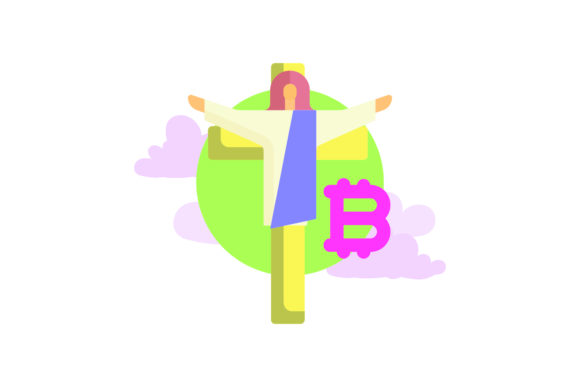
You will find this fusion most commonly in the form of digital art, memes, and NFTs (non-fungible tokens). A typical image might show a crowned Jesus wearing a purple robe, holding a Bitcoin instead of a lamb, with the words "He Is Risen" replaced by "The Bottom Is In." Alternatively, you might see a purple Easter egg etched with the Bitcoin logo, cracked open to reveal a glowing orange coin inside. These images circulate on social media platforms like X (formerly Twitter), Reddit, and Telegram, especially around Easter weekend.
The practical relevance extends beyond mere humor. For many in the crypto space, these symbols serve as a form of identity expression. They signal membership in a community that shares a common narrative. Wearing a purple Bitcoin cross or sharing a meme of the "Bitcoin Jesus" is a way of saying, "I am part of this movement. I understand the story. I am willing to endure the passion for the resurrection." It is modern-day iconography used for tribal bonding.
Examples in Community and Business
Some crypto-themed churches and gatherings have adopted this imagery. The "Bitcoin Church" movement, for instance, uses Easter-style iconography to frame financial education as a form of spiritual awakening. Purple banners with Bitcoin logos are hung alongside crosses. In the creative sector, graphic designers offer custom "Bitcoin Jesus" artwork for sale, often in purple tones, for use in profile pictures or merchandise. On the business side, a few crypto exchanges have run Easter promotions featuring purple-themed Bitcoin eggs in their marketing, drawing on the resurrection narrative to suggest that now is the time to "rise" from the financial dead.
Common Misunderstandings
It is important to address a few assumptions that readers might have. First, this blending is not typically intended as blasphemy. While some may find it offensive to mix religious imagery with a financial asset, most creators and sharers are not mocking Christianity. Instead, they are using a shared cultural vocabulary to tell a story about value and resilience. They assume that the audience recognizes the Easter story well enough to understand the metaphor.
Second, the "purple" element is often mistaken for mere aesthetic preference. As we have seen, purple is deeply rooted in both royal and penitential symbolism, making it the perfect color to express the dual nature of the Bitcoin journey—suffering and kingship. Ignoring that context leads to a shallow understanding of the icon.
Third, some assume that this fusion is a recent fad. In reality, the connection between Bitcoin and religious symbolism has been present since at least 2013, when the first "Bitcoin Jesus" memes appeared. The Easter and purple variants are an evolution of a longer tradition within the crypto culture of borrowing from religious language (e.g., "the whitepaper is the scripture," "HODL is the prayer").
Broader Understanding: Why This Matters Today
In an era of information overload, symbols are powerful shorthand. They compress complex ideas into a single image. The Bitcoin Easter icon with Jesus in purple is a case study in how digital communities create meaning. It combines a religious festival (Easter), a religious figure (Jesus), a color (purple), and a technology (Bitcoin) into a coherent message: believe, suffer, rise, reign.
For the general reader, understanding this fusion offers a window into how modern subcultures operate. It shows that even in a field as technical as cryptocurrency, human beings still crave narratives, myths, and symbols. We cannot operate on code alone; we need stories that give our efforts meaning. The purple-clad Bitcoin Jesus is one such story. It helps people navigate the emotional highs and lows of a volatile market by framing them as part of a larger, meaningful journey.
Moreover, this symbol has practical relevance for educators and communicators. If you are trying to explain Bitcoin to a skeptical audience, drawing on familiar Easter imagery can make the concept more accessible. You can say, "Bitcoin is like the Easter story—every time it seems dead, it comes back to life." That analogy resonates because it taps into a story that millions already understand.
In conclusion, the Bitcoin Easter icon featuring Jesus in purple is far more than a quirky internet meme. It is a carefully layered symbol that speaks to sacrifice, royalty, resurrection, and community identity. By unpacking its components—Easter's renewal, Jesus's sacrifice, purple's dual meaning of suffering and kingship—we gain insight into the heart of Bitcoin culture. Whether you are a crypto enthusiast, a curious observer, or someone interested in how symbols evolve in the digital age, this fusion offers a fascinating glimpse into the human need to create meaning at the intersection of faith and finance. The next time you see that purple-robed figure holding a Bitcoin, you will know the full story behind the image. And understanding that story, in the end, is what truly matters.